
Ask three packaging suppliers to quote a shipping solution for the same part and you'll get three very different sticker prices: a corrugated tray for a few dollars, a wood crate for a bit more, and a welded steel rack that costs many times either one. On that comparison alone, steel looks expensive and the decision looks easy. But sticker price is the wrong number. Steel, wood, and cardboard aren't really competing on what they cost to buy — they're competing on cost per trip and on how well they protect the part in transit. Once you look at the material through those two lenses, the ranking often flips.
This is a buyer's comparison for packaging engineers and purchasing teams weighing returnable steel racks against wood crates and corrugated for moving parts between plants. We build the steel side, so we'll be upfront about where steel is the wrong answer too.
The real comparison isn't sticker price
A one-way corrugated box that costs a few dollars sounds cheap until you remember you buy it again on every single shipment, plus the labor to erect and tape it, plus the disposal on the receiving end. A steel rack costs far more once, then amortizes across hundreds of loops. The honest way to compare materials is to divide the fully loaded cost of packaging — purchase, labor, freight, storage, damage, and disposal — by the number of trips each unit actually completes. That number, not the price on the PO, is what hits your annual spend. We walk through the full math in how to calculate cost per trip, and the broader trade-off in returnable vs. expendable packaging.
| Factor | Steel (returnable) | Wood | Cardboard / corrugated |
|---|---|---|---|
| Durability / trips | Hundreds of trips; engineered for reuse | A handful of trips before splitting or nailing loosens | Effectively one-way; crushes and softens quickly |
| Part protection | Fixed locations, dunnage and foam; parts don't shift | Moderate; parts often loose or hand-blocked | Low for heavy or finish-critical parts |
| Cost per trip | Low once volume and trips are high | Middling; re-bought often | High over time; bought every shipment |
| Weight & freight | Heaviest per unit, but stacks and returns densely | Moderate weight, awkward to nest | Lightest outbound; poor stacking when loaded |
| Moisture / ESD / cleanliness | Sealed coatings; wipes clean; no splinters | Absorbs moisture; splinters; loose fasteners | Absorbs moisture; sheds fiber/dust |
| Repairability | Weld, straighten, re-coat and return to service | Limited; usually cheaper to scrap | None |
| Disposal / waste | Minimal recurring waste; asset stays in loop | Recurring wood waste; ISPM-15 handling for export | High recurring cardboard waste stream |
| Sustainability | Reused for years; fully recyclable at end of life | Renewable but consumed per trip | Recyclable but single-use; heavy per-trip footprint |
Durability and service life
This is where the three materials diverge the most. A well-built returnable steel rack is designed to run hundreds of loops, and when it does get damaged it can be straightened, re-welded, and re-coated rather than thrown away. Wood crates and pallets survive a handful of trips before boards split, fasteners work loose, and the unit stops holding tolerance. Corrugated is essentially single-use for anything with weight to it — one rough handling event or one damp warehouse and it's compromised. Across a multi-year program, a single steel unit can outlast dozens or hundreds of expendable ones, which is the whole reason the up-front premium amortizes away.
Part protection and damage
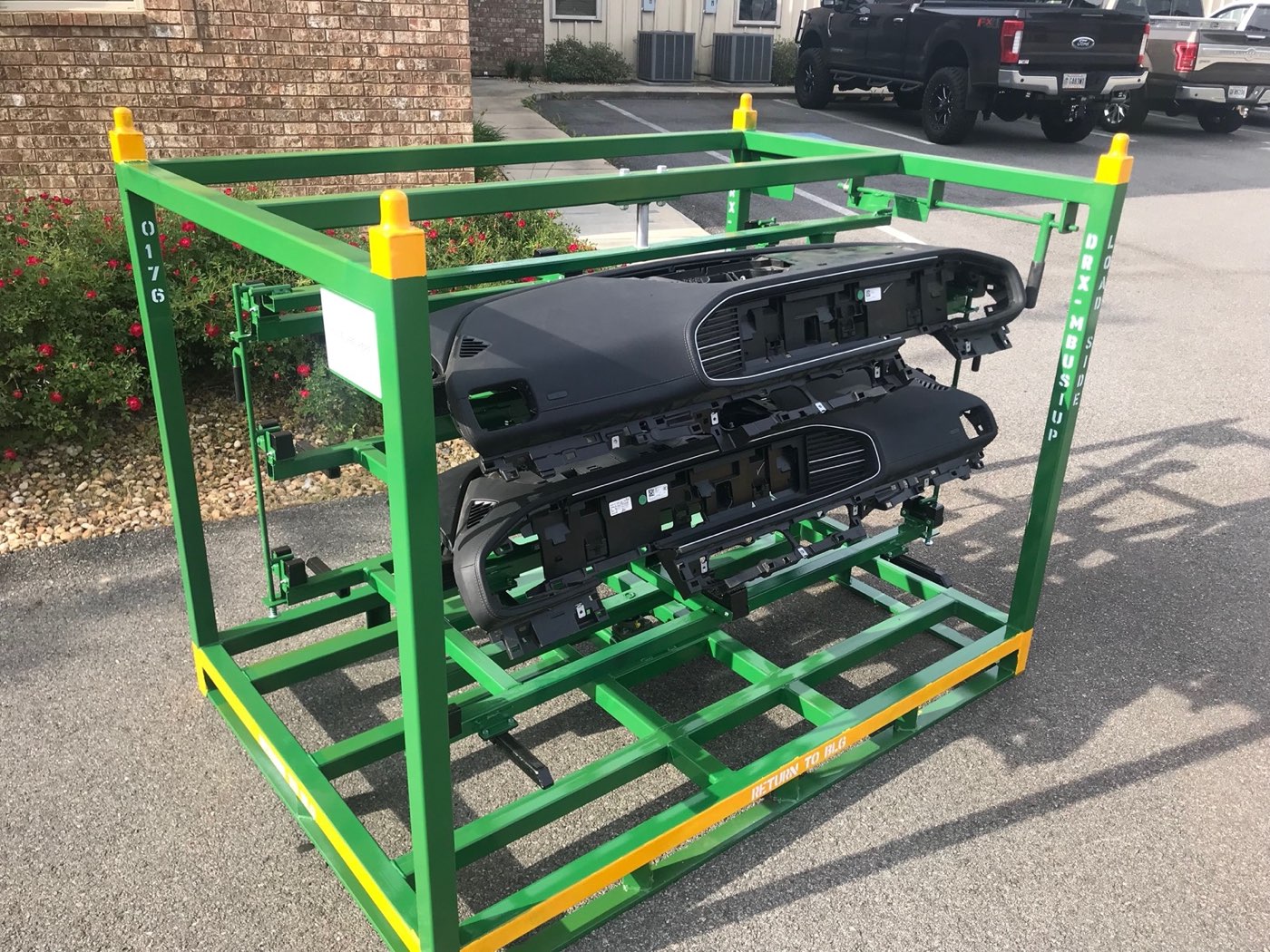
Packaging exists to deliver a good part, and damage in transit is usually the most expensive line item nobody quotes. Steel racks hold parts in engineered locations — pockets, cradles, and uprights sized to the part — so nothing shifts, stacks on itself, or rubs a finished surface. Add custom dunnage and foam inserts and you get repeatable, part-specific protection trip after trip. Wood blocking and corrugated dividers can work for lighter or lower-value parts, but they rely more on how carefully each load is packed by hand, and they degrade as the container ages. For heavy, machined, painted, or finish-critical parts, the difference in scrap and rework tends to dwarf any savings on the packaging itself.
Weight, freight, and density
Steel's obvious downside is weight — a steel rack is heavier per unit than a wood crate or a cardboard box, and that costs something on the outbound leg. But freight is about density and the round trip, not just tare weight. Well-designed racks stack and interlock so you ship more parts per truck outbound, and stackable or collapsible designs bring the empties back densely on the return leg instead of hauling air. That return-trip efficiency is what makes the returnable model pencil out; we compare the two empty-return strategies in stackable vs. collapsible racks. Cardboard is lightest going out, but loaded cartons stack poorly and you're paying freight on packaging you throw away at the destination.
Cleanliness, moisture, and the wood problem
Wood has real handling drawbacks in a plant. It absorbs moisture, which matters for corrosion-sensitive parts; it produces splinters and loose fasteners that end up in the load or on the line; and it sheds debris that's a problem in clean or ESD-sensitive environments. Cardboard sheds fiber and dust and collapses when it gets damp. Steel doesn't splinter, wipes down, and carries a sealed coating — powder coat or wet paint — that resists moisture and holds up to repeated washing. For parts that go straight to an assembly line or a controlled area, that cleanliness is often decisive on its own, separate from any cost argument.
One-way waste and disposal
Every expendable shipment creates a waste stream on the receiving dock: broken-down cardboard to bale and haul, or wood to landfill or grind. That's recurring labor and recurring disposal cost, and for high-volume lanes it adds up to a meaningful number that rarely appears in the packaging quote. A returnable steel asset stays in the loop; the recurring waste is essentially the dunnage or foam that eventually wears out, not the container.
Sustainability and reuse
The most sustainable package is usually the one you don't rebuild every trip. Steel racks are reused for years and are fully recyclable at true end of life, so the material footprint spreads across thousands of parts. Wood is renewable but consumed per trip, and export wood carries ISPM-15 heat-treatment obligations. Cardboard is recyclable but single-use, so its per-trip footprint stays high no matter how green the fiber source. If corporate sustainability targets are part of your scorecard, cost per trip and carbon per trip tend to move in the same direction — toward reuse.
Bottom lineOn repeat domestic lanes with steady volume and parts worth protecting, returnable steel wins on cost per trip and on scrap — the up-front premium is bought back within the program.
What we see on the floor
Southern Perfection has designed and built returnable steel racks in Byron, GA since 1982, and the pattern is consistent: buyers who compare on sticker price alone over-buy expendable packaging and quietly absorb the damage and disposal costs downstream. When we sit down with a part and its actual lanes, the conversation moves off price-per-unit and onto trips per year, parts per truck, and scrap rate. From there we design the container and the protection together — laser-cut and formed steel, robotically and manually welded by AWS-certified welders, powder coated, then fitted with dunnage and foam shaped to the part on our own CMM-verified tooling. Because it's all under one roof, the rack and the part protection are engineered as one system rather than bolted together after the fact. That's the difference that shows up as fewer damaged parts three years into a returnable packaging program.
Every part protects differently — send us your part and lanes and we'll compare materials on your real numbers.
When wood or cardboard is the right choice
Steel isn't the answer for every shipment, and it's not honest to pretend otherwise. Wood or cardboard is usually the better call when the loop is one-way and you'll never see the container again; when volume is very low and you'll never accumulate enough trips to amortize a steel asset; when you're crating for export and need ISPM-15-compliant wood anyway; or when the part is ultra-light and low-value enough that a corrugated box protects it fine. If your lane looks like any of those, expendable packaging is the rational choice — the point of the comparison isn't "steel always," it's matching the material to the trip count and the part.
Frequently asked questions
Is steel packaging always more expensive than wood or cardboard?
Up front, yes — a steel rack costs several times a wood crate or a corrugated box. Over a program it's usually cheaper, because you reuse one steel asset across hundreds of trips instead of re-buying expendable packaging every shipment. The deciding number is cost per trip, not the purchase price.
How many trips does a returnable steel rack last?
A well-built rack is designed for hundreds of trips, and because steel can be straightened, re-welded, and re-coated, a damaged unit goes back into service rather than to scrap. Wood typically lasts a handful of trips and cardboard is effectively single-use.
At what volume does steel start to beat expendable packaging?
There's no universal threshold — it depends on trip count, freight, damage rate, and disposal cost on your specific lane. The practical approach is to calculate cost per trip for each material using your real numbers; steel tends to win on repeat domestic lanes with steady, meaningful volume.
Does steel packaging cost more in freight because it's heavier?
Steel is heavier per unit, so the outbound leg costs a bit more. But freight is driven by density and the round trip, and racks that stack outbound and return densely — stacked or collapsed — often move more parts per truck and haul back less air, which offsets the tare weight.
When should I still choose wood or cardboard?
Choose expendable for one-way lanes you won't recover, very low volumes that never amortize a steel asset, export crating that needs ISPM-15 wood, or ultra-light low-value parts a box protects fine. Match the material to trip count and part value rather than defaulting to either extreme.