
Every returnable packaging decision eventually lands on one desk, and it always gets the same objection: "A steel rack costs ten times what a cardboard box costs — how is that cheaper?" It's a fair question with a simple answer, but you can't win it by comparing sticker prices. You win it with a single number: cost per trip. Get that number right and the business case makes itself. Get it wrong — or leave costs out of it — and a program that would have saved six figures dies in a budget meeting.
This is the framework we walk buyers through when they send us a part and a set of lanes. It's the same math whether you're shipping stampings to an assembly plant or finished appliances to a DC.
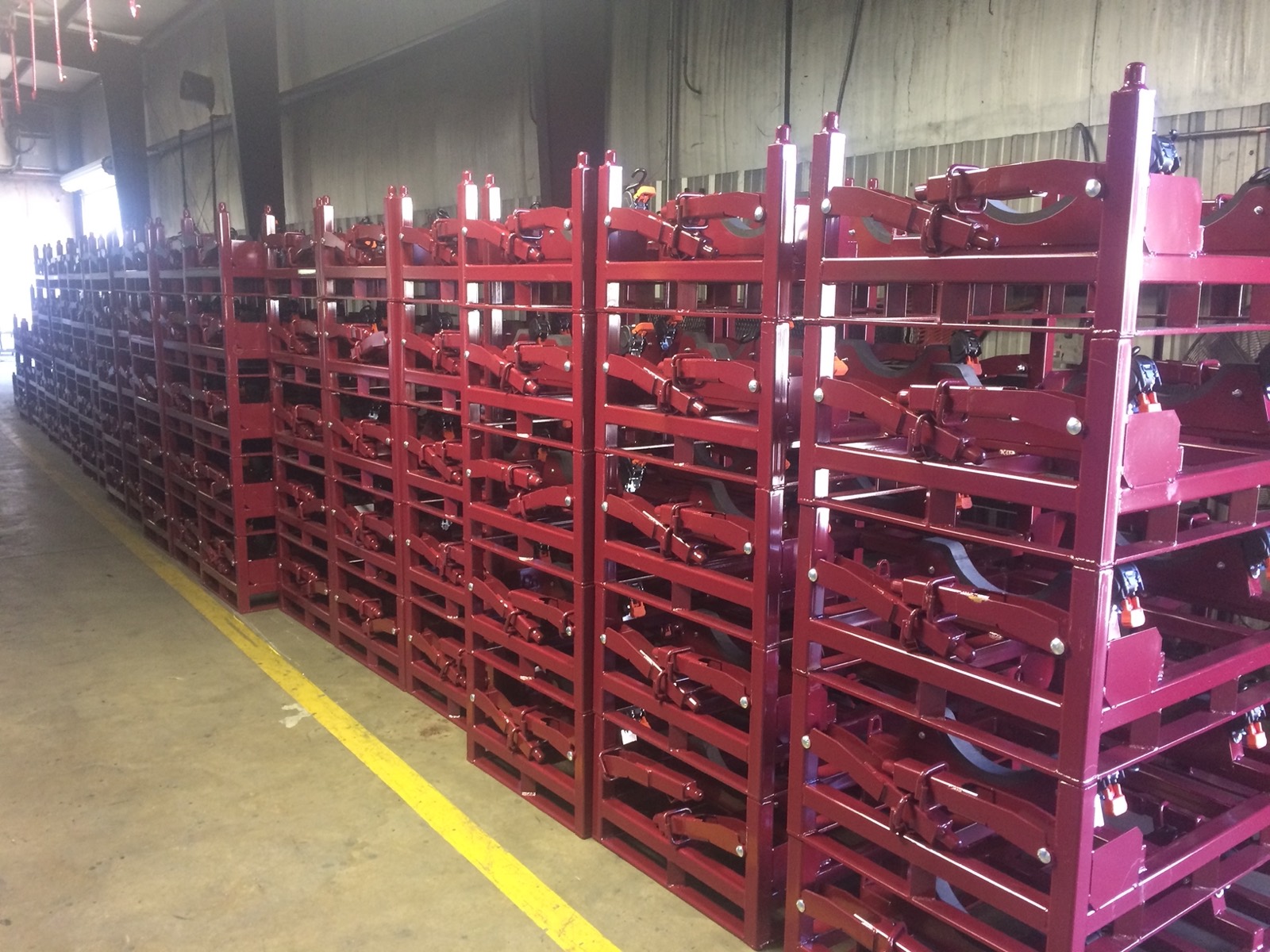
Start with cost per trip, not sticker price
A returnable steel rack is a capital asset that gets amortized across hundreds of shipments. Expendable packaging — cardboard, wood crates, foam, stretch wrap — is an expense you pay again on every single shipment, forever. Comparing the one-time cost of the first against the per-shipment cost of the second is the mistake that sinks most evaluations. Put both on the same footing — dollars per trip — and you're finally comparing like for like.
The cost-per-trip formula
The core calculation is short:
The formulaCost per trip = (rack cost + lifetime repair & refurb − salvage value) ÷ total trips over service life
Three of those four inputs are where teams go wrong:
- Total trips is the biggest lever, and the most underestimated (more on that below). It's trips per year × service life in years.
- Lifetime repair & refurb isn't a penalty — it's what extends the denominator. A rack that can be repaired and refurbished keeps earning trips long after a welded-shut design would have been scrapped.
- Salvage value is real: steel has scrap value at end of life, so the true cost is slightly lower than the purchase price suggests.
A worked example
Here's the calculation on a realistic mid-duty rack. These numbers are illustrative — plug in your own — but the ratio is representative of what we see on controlled, higher-volume lanes.
| Cost element | Returnable steel rack | Expendable (per shipment) |
|---|---|---|
| Up-front / material cost | $600 (one time) | $9.00 / trip |
| Pack / unpack labor | Lower, reusable | $2.00 / trip |
| Average transit damage | Minimal (fixtured) | $2.00 / trip |
| Disposal per cycle | $0 | $0.50 / trip |
| Lifetime repair & refurb | + $80 | — |
| Salvage (scrap steel) | − $40 | — |
| Trips over service life | 500 | 500 |
| Cost per trip | ≈ $1.28 | ≈ $13.50 |
Over 500 trips, that's roughly $640 in the rack vs. $6,750 in expendable packaging for the same lane — about a 10× difference, and that's before you count warehouse floor space, the purchasing overhead of reordering packaging every week, or the cost of a line-down event when a one-way box fails. Run this across a fleet of a few hundred rack positions and the annual number gets everyone's attention.
The costs expendable packaging hides
Sticker price is the part everyone sees. The savings live in the costs that never make it onto the packaging line item:
- Transit damage. Cardboard and loose dunnage let parts shift, rub, and stack-crush. A rack with proper foam inserts or dunnage holds each part in a dedicated pocket. Scrapped parts, rework, and a stopped line dwarf anything you spend on packaging.
- Repeat purchasing. Every expendable shipment is a new PO, a new receipt, and a new payment. That procurement overhead is invisible on a per-box basis and enormous across a year.
- Disposal & handling labor. Someone breaks down, bales, stores, and disposes of one-way packaging on every cycle — and pays to haul it away.
- Freight density. A rack engineered to cube out the trailer — right footprint, stackable, nesting — ships more parts per truck. Better density can cut your freight cost per part more than the packaging itself.
- Line-side ergonomics. Parts presented at the right height and orientation speed the operator and cut damage at the point of use. Expendable rarely does this well.
Trips per year: the multiplier teams underestimate
Because trip count sits in the denominator, it swings the answer more than any other input — and it's the one people lowball. A rack isn't "used once"; it cycles for years on a controlled loop:
- A weekly closed-loop lane ≈ 50 trips/year → 250+ trips over five years.
- A daily milk-run can exceed 200 trips/year → over 1,000 lifetime trips.
Every additional trip drives cost per trip down. This is exactly why refurbishment matters: extending service life by even a year or two, instead of scrapping a bent rack, meaningfully lowers the lifetime number.
What we see on the floor
Two patterns come up again and again when we build and service returnable fleets from our shop in Byron:
The failure point is almost never the steel — it's the moving parts and the pockets. On collapsible designs, hinges and latches take the abuse; on stackable designs, it's the stacking feet and locators. Racks designed so those wear points can be replaced, rather than requiring the whole unit to be scrapped, are the ones that quietly deliver the best cost per trip. That's why we run a repair and refurbishment program rather than just selling new steel.
The best-performing racks are the ones spec'd around the part, not the trailer alone. When the pocket geometry protects the part and the outer footprint still cubes the truck, damage and freight both drop at once. Getting that right up front is worth more than shaving a few dollars off the rack. Our free guide to speccing a returnable rack walks through the trade-offs.
Program specifics vary by part, lane, and duty cycle — send us yours and we'll pressure-test the assumptions against your real numbers.
Where the math flips to expendable
Returnables aren't always the answer, and it's worth being honest about that. Expendable can still win when:
- The lane is one-way or the return leg is uncontrolled, so racks won't reliably come back.
- Volume is low or sporadic — not enough trips to amortize the asset.
- The part is short-lived (a program ending soon) and won't rack up the trips.
- Return freight on empties would eat the savings — though a stackable or collapsible design often solves that.
For a fuller side-by-side, see returnable vs. expendable packaging. The point of the exercise isn't to reach a predetermined answer — it's to reach the right one for your lanes.
Building the business case
To take this to finance, put three numbers on one page: (1) cost per trip for each option using the formula above, (2) annual spend at your real trip volume, and (3) simple payback — the up-front rack investment divided by the per-trip savings × trips per year. In most controlled, repeating lanes the payback lands inside the first year, and everything after that is margin. Frame it as an asset with a return, not a packaging expense, and the conversation changes.
Frequently asked questions
How many trips does it take for a returnable rack to pay off?
Divide the rack's up-front cost by the per-trip savings versus your current expendable packaging. In the example above — $600 rack, roughly $12/trip in savings — payback lands near 50 trips, often inside the first year on a weekly or daily loop. High-volume lanes pay back faster.
What's a typical service life for a returnable steel rack?
A well-built, properly spec'd steel rack runs for years and hundreds of trips. Service life depends far more on design and upkeep than on age: racks whose wear points can be repaired and refurbished stay in service long after fixed designs would be scrapped.
Do returnables make sense for low-volume shipping?
Sometimes not. If a lane is one-way, very low volume, or tied to a program that's ending soon, expendable packaging can be the cheaper choice. Cost per trip tells you where the line is for your specific volume.
How do you keep return freight from eating the savings?
Design for the empty return, not just the loaded trip. Stackable and collapsible racks knock down or nest so you ship far more empties per trailer on the way back — often the difference between a program that pencils out and one that doesn't.
What happens when a rack gets damaged?
It gets repaired, not discarded. Bent members, worn hinges, and damaged locators are replaceable. Refurbishment restores the rack to service and extends the trip count it's amortized over — which is exactly what lowers lifetime cost per trip.