
If you own a fleet of returnable steel racks, this decision lands on your desk on a predictable cycle: racks come back from the loop bent, worn, or rusted, and someone has to say whether they go to the repair bay or the scrap pile. It's tempting to make it a reflex. “Just buy new” feels clean and low-risk — but it quietly writes off tons of perfectly sound steel and burns capital a refurbishment would have preserved. “Repair everything” feels thrifty, but it can push a rack with a cracked primary weld or corroded structure back onto a truck, where a failure isn't a budget problem anymore.
The honest answer is that neither reflex is right. Repair-or-replace is a per-condition judgment, and the good news is that it follows a small set of rules you can apply on the receiving dock. Here's the framework we use, and where the lines actually fall.
The repair-or-replace decision in one line
Refurbish when the damage is localized and the core structure is sound; replace when the structure itself is compromised, the design no longer fits the part, or the cost to make it right approaches the cost of a new rack. Almost everything below is just detail on those three tests.
A simple cost rule of thumb
Start with money, because it settles most cases quickly. Estimate the all-in repair cost — labor, replacement members, refinishing, inspection — and compare it to what a new rack of the same design would cost today. If the repair runs a small fraction of replacement, refurbish without much debate. As the repair estimate climbs toward the price of new, the case for buying flips.
Where's the line? It varies by rack and by how much service life is left, but as an illustrative benchmark, many fleets draw it somewhere around 50–60% of replacement cost — repair below that band, replace above it. Treat that as a starting point for discussion, not a law of physics: a rack that's otherwise in early life justifies a higher spend than one already near the end of its service window. The number is a prompt to do the math, not a substitute for it.
What's repairable vs. what isn't
Cost tells you whether to bother; condition tells you whether you safely can. Some damage is routine to correct and some is a signal the rack has reached end of life. The split usually looks like this:
| Condition | Typical call | Why |
|---|---|---|
| Bent uprights, posts, or cross members | Repair | Straighten or cut-and-replace the member; the frame geometry is recoverable. |
| Worn hinges, latches, or pins | Repair | Wear items are designed to be swapped without touching the structure. |
| Damaged part locators or dunnage | Repair | Locators are bolt-on or weld-on; restoring them re-qualifies the rack to the part. |
| Finish failure — rust, chipped coating | Repair | Blast and re-coat; protects the part and adds years, provided the steel underneath is sound. |
| Cracked primary / load-bearing welds | Case-by-case → often replace | A primary weld crack can mean fatigue in the surrounding steel, not just the joint. Inspect before committing to repair. |
| Corrosion through section (pitting, wall loss) | Replace | Once a member is corroded through, its rated capacity can't be trusted even after refinishing. |
| Safety-critical structural deformation | Replace | Deformation that changes how the rack carries load isn't a cosmetic fix — the safety margin is gone. |
The pattern: bent members, worn wear-items, and finish are the bread and butter of refurbishment. Cracked primary welds, corrosion through the section, and load-path deformation are where you stop and think hard — and usually replace.
Rule of thumbRepair localized damage on a sound structure; replace when the structure, the fit to the part, or the repair cost is compromised.
Why this is really a cost-per-trip decision
The reason refurbishment usually wins on the numbers is that a returnable rack's true cost isn't its purchase price — it's its cost per trip across a full service life. A refurbished rack keeps earning trips against capital you already spent, which drives that per-trip number down instead of resetting the clock with a new-build PO. Two or three refurbishment cycles over a rack's life can be dramatically cheaper than replacing the fleet on the same timeline, and the math is the same logic behind any returnable program. If you want to run it for your own fleet, our returnable packaging ROI breakdown walks through cost per trip, and the broader case for a returnable packaging system explains why extending asset life is where the savings actually live.
Safety and quality: inspect before it re-enters service
A returnable rack isn't a warehouse shelf — it carries parts over the road, gets forked, stacked, and dropped, and then rejoins a rotation where operators trust it. That changes refurbishment from a cosmetic exercise into a qualification step. A rack that has been repaired needs to be inspected and confirmed back to spec before it's cleared for service, not just wiped down and sent out. That means checking weld integrity, verifying critical dimensions and locators (we use CMM inspection where it matters), and confirming the finish will actually protect the part through the loop. Doing repairs in a shop with a real quality system — Southern Perfection is ISO 9001 registered, CAGE 2W654 — is the difference between a rack that looks fixed and one that's documented as fit to carry load again.
What we see on the floor
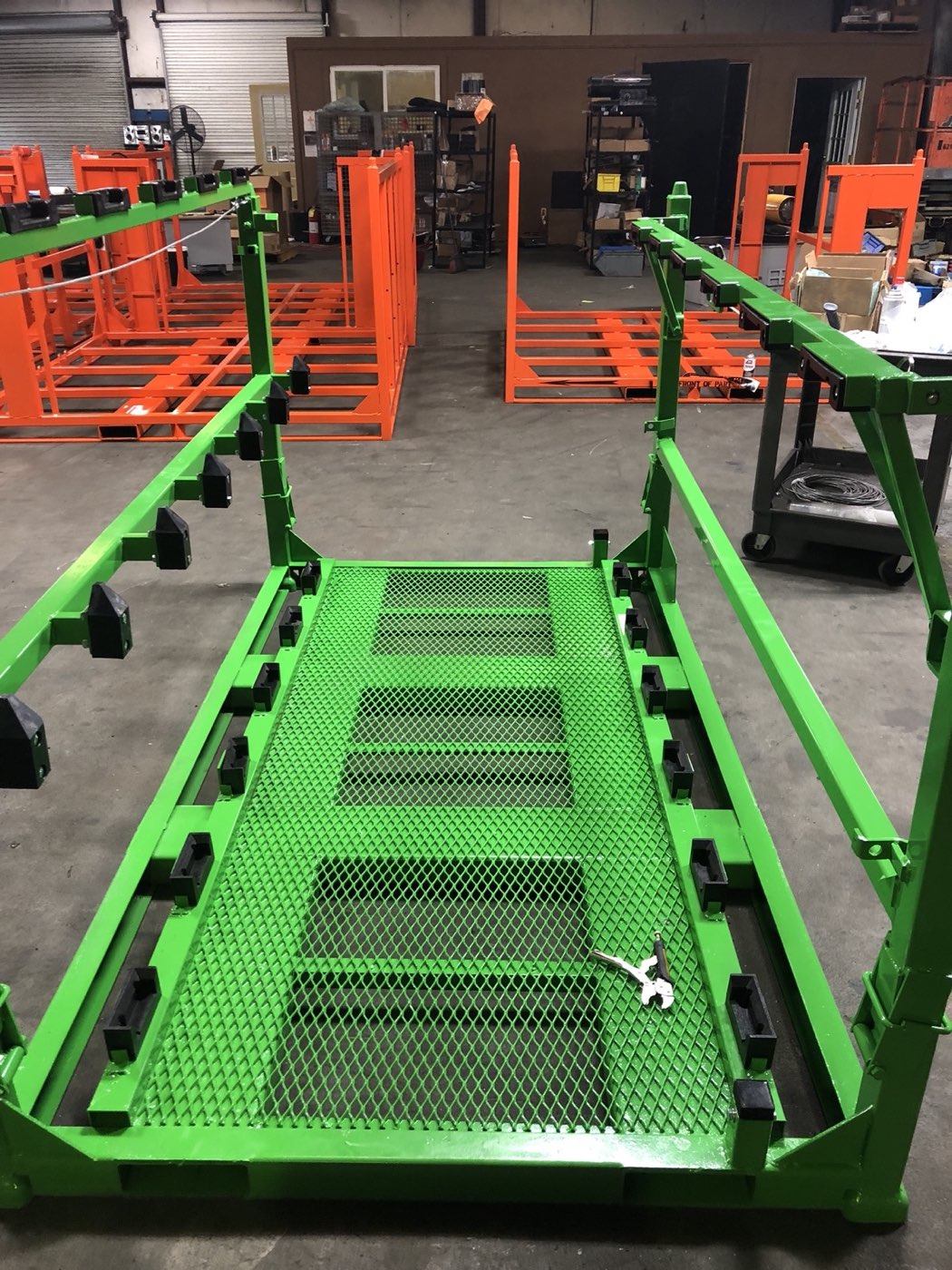
Southern Perfection has designed and built returnable racks in Byron, GA since 1982, and we run a dedicated rack repair & refurbishment program that services OEM fleets on a recurring basis. Because we also build these racks — in-house forming, 30+ MIG welding stations, FANUC robotic welding, AWS-certified welders, and powder coating under one roof — we already know where each design tends to fail, which makes the repair faster and truer to the original spec than a general weld shop can manage. The most common thing we see: fleets that were about to be scrapped wholesale, where two-thirds of the racks only needed a straightened member, a new latch, and a re-coat. The genuinely dead ones are usually obvious — corroded through, or bent in the load path. Sorting the two is the whole job.
Fleet condition varies — send us photos or a sample rack and we'll tell you repair vs. replace, honestly.
When replacement is the right call
Refurbishment isn't always the answer, and we'll say so. Replace when the part itself has changed — new geometry the old rack simply can't hold or protect, no matter how well it's repaired. Replace when the original design was wrong from the start: poor density, bad ergonomics, or inadequate protection that refurbishment would only preserve. Replace when damage is so widespread that the honest repair estimate lands at or above new-build cost. And replace when the structure is compromised in a way inspection can't clear — corrosion through section or deformation in the load path. In those cases, pouring money into repair just delays a purchase you'll make anyway. If it's time to rebuild the design, our guide on how to spec a returnable rack is the right starting point, and for common formats it's worth reviewing automotive racks and stack racks before you commit.
Frequently asked questions
How do I decide whether to repair or replace a returnable rack?
Apply three tests: is the core structure sound, does the rack still fit the current part, and is the estimated repair cost well below the cost of a new rack? If all three hold, refurbish. If any one fails — compromised structure, changed part, or repair cost approaching new — replacement is usually the better call.
At what point does repairing a rack stop making financial sense?
As an illustrative benchmark, many fleets treat roughly 50–60% of replacement cost as the line: below it they repair, above it they replace. The exact threshold depends on how much service life the rack has left, so use it as a prompt to run the numbers rather than a fixed rule.
Which kinds of rack damage are typically repairable?
Bent uprights and cross members, worn hinges, latches, and pins, damaged part locators, and finish failure like rust or chipped coating are all routine refurbishment work, as long as the underlying steel is sound. Cracked primary welds, corrosion through the section, and safety-critical deformation are the cases that usually mean replacement.
Does a repaired rack need to be inspected before going back into service?
Yes. A returnable rack carries parts over the road, so a repaired rack should be inspected and confirmed back to spec — weld integrity, critical dimensions, locators, and finish — before it re-enters the rotation. A shop with a real quality system documents that the rack is fit to carry load again.
Can I get racks repaired if a different company built them?
Yes. We refurbish returnable steel racks regardless of who originally built them, and we service OEM fleets on a recurring basis. The best first step is to send photos or a sample rack so we can give you an honest repair-vs-replace call before any work starts.