
Every returnable rack makes the same round trip twice a cycle: loaded on the way out, empty on the way back. Most programs are engineered around the loaded leg and treat the return as an afterthought — which is exactly where returnable programs quietly win or lose money, because on the empty leg you are paying full freight to move air. The single biggest lever on that empty-return cost is whether your rack is stackable or collapsible. This piece walks through how each format returns, how to think about the trade-off, and how to match the choice to your lane.
Why the empty return leg drives the math
A trailer costs roughly the same to run whether it is full or nearly empty. Fuel, driver hours, tolls, and the lane rate are all largely fixed per trip. So the real question on the return leg is not "what does it cost to move a trailer?" — it is "how many empty racks can I get into that trailer?" The fewer trailers you need to bring empties home, the lower your total freight per cycle.
For a rigid rack that comes back the same size it went out, the empty leg can cost nearly as much as the loaded one — you are hauling the same cube with none of the revenue-bearing parts inside. That is why returnable packaging programs live or die on return density. A rack that folds or nests flat turns several empty return trailers into one, and that saved trailer is close to pure margin.
How stackable racks return
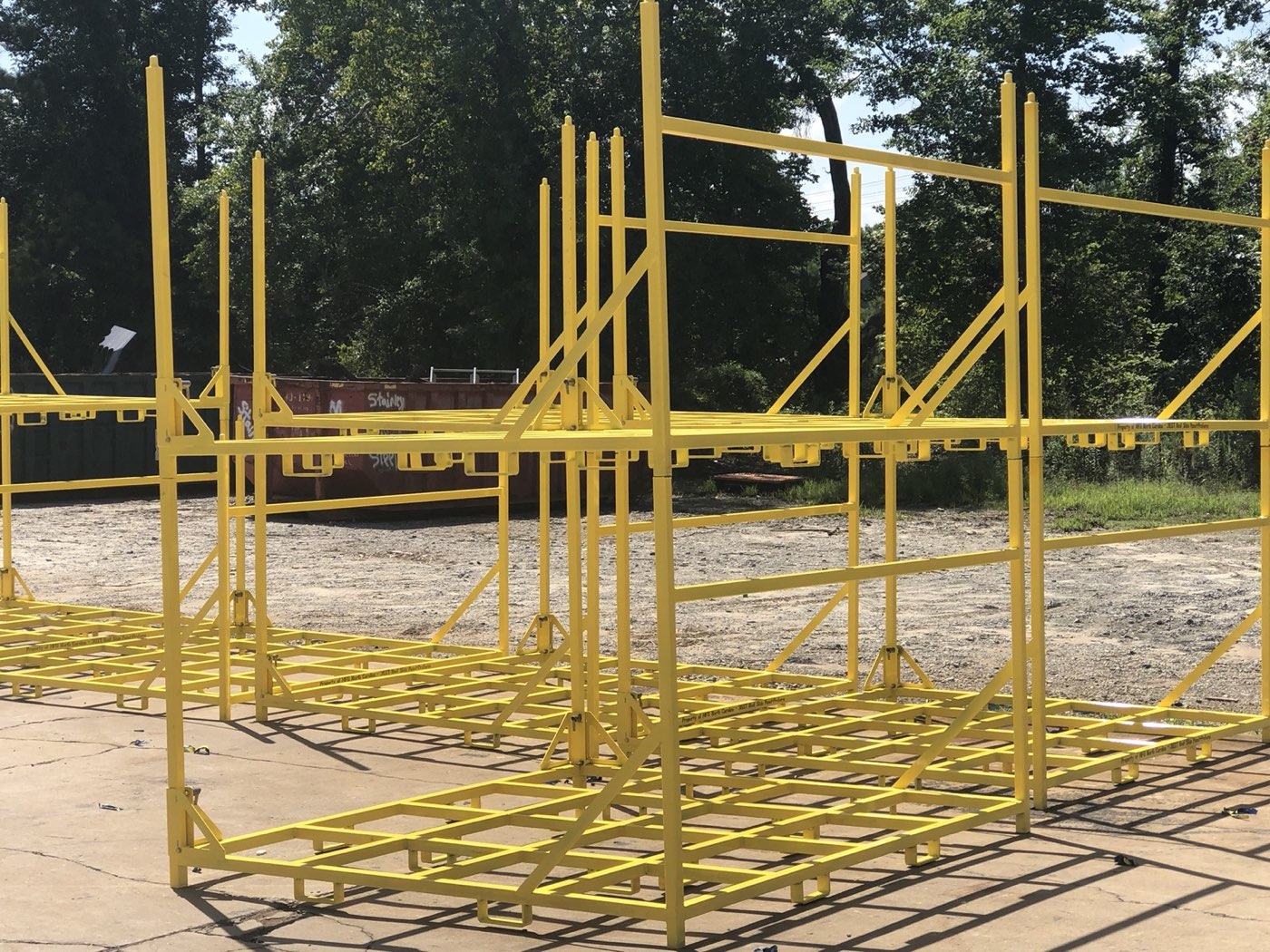
Stackable racks — the classic stack rack — are rigid steel frames, usually with removable or fixed posts, designed to stack on top of one another both loaded and empty. On the loaded leg, stacking is the whole point: you build a column of loaded racks and use the full interior height of the trailer, cubing out the load instead of leaving air above a single tier.
On the empty leg, stackable racks come back in one of two ways. Some designs simply stack empty at the same footprint they occupied loaded, so the return density is no better than the outbound density — you are shipping the same cube back. Better designs nest or interlock when empty: posts drop into pockets, or frames telescope together, so an empty stack is shorter than a loaded one. Nesting recovers some return density without any moving parts to maintain, which is the appeal — a stackable rack is essentially a welded box, and there is very little to break.
How collapsible racks return
Collapsible racks — also called knock-down or fold-flat racks — are engineered to come apart or fold down when empty. Hinged posts fold onto the base deck, or removable uprights drop into a gather on the deck, so the empty rack collapses to a fraction of its loaded height. Several collapsed racks then stack into the vertical space a single loaded rack would occupy.
The result is a high return ratio: where a rigid rack returns one-for-one, a well-designed collapsible rack might return four, five, or more empties in the same trailer slot (treat those figures as illustrative — the real number depends entirely on the fold geometry). On long or high-frequency return lanes, that folding action can pay back the higher up-front cost of the rack on return freight alone. The trade-off is mechanical: hinges, pins, and latches are moving parts, and moving parts wear, get abused on the dock, and occasionally need repair over a fleet's life.
Stackable vs. collapsible at a glance
| Factor | Stackable | Collapsible / knock-down |
|---|---|---|
| Empty return density | Low to moderate — best with nesting/interlock | High — folds flat, several empties per loaded slot |
| Durability / moving parts | Rugged; few or no moving parts to fail | Hinges, pins, latches add wear points |
| Up-front cost | Generally lower per rack | Generally higher per rack |
| Handling labor at pack-out | Minimal — stack and go | More — fold/knock down before loading empties |
| Best-fit lane | Short loops, high loaded density, heavy abuse | Long or frequent return lanes with costly empty freight |
The concept of a return ratio
The cleanest way to compare the two formats is a return ratio: how many empty racks fit in the trailer space of a single loaded rack. A rigid rack that comes back at full size has a return ratio near 1:1 — one trailer of empties for every trailer of loaded parts. A rack that nests might reach 2:1 or 3:1. A collapsible rack that folds flat might reach 4:1 or higher.
Those numbers are illustrative, not promises — your actual ratio falls out of the fold or nest geometry, the part height, and the trailer. But the ratio is the number that matters, because it maps almost directly to how many return trailers you pay for. Double your return ratio and you roughly halve the trailers required to bring empties home. On a long, frequent lane, that difference dominates the total cost of the program.
The trade-offStackable racks are simpler and tougher and win on short loops; collapsible racks cost more and add moving parts but slash empty-return freight on long, high-frequency lanes.
Tying it back to cost per trip
Return ratio only becomes a dollar figure when you push it through your actual freight. That is the job of a cost-per-trip model: total the rack's up-front cost, its expected trips over its service life, the loaded freight, and — the piece most people underweight — the empty-return freight driven by return density. Our returnable packaging ROI walkthrough lays out how to build that per-trip number and where empty-return cost hides inside it.
When you run the numbers, a collapsible rack's higher purchase price often disappears against the trailers it saves on the return leg — but only if the lane is long enough or runs often enough for that saving to accumulate. On a short in-town loop, the folding advantage never gets a chance to pay for itself. The model, not the brochure, tells you which side you are on.
What we see on the floor
Southern Perfection Fabrication has designed and built returnable steel racks — stackable, collapsible, and fully custom — in Byron, GA since 1982, so we see how both formats behave across real programs. A few patterns hold up consistently. Collapsible designs earn their keep when the return lane is long and the empties would otherwise ship at low density; the folded return density is what makes the whole program pencil out. Stackable designs win when the loop is short, the parts are heavy or abusive, or the customer's dock crew will not reliably fold racks down at pack-out — a collapsible rack that never gets collapsed returns like a rigid one and just costs more.
Because we design in-house in SolidWorks and cut, form, weld, and powder-coat under one roof, we can tune the fold geometry, post spacing, and nesting to your specific part and trailer rather than forcing it onto a catalog rack. If you are still upstream of a decision, our guide on how to spec a returnable rack covers the inputs — part, lane, dock, volume — we need to get the format right. The same logic extends to industrial metal containers for bins and totes, and to automotive racks for Tier-1 lanes.
The right answer depends on your lane, dock, and part — send us the details and we'll model the return freight both ways.
When neither knock-down nor stacking is worth it
Sometimes the honest answer is that neither optimization earns its cost. On a short, simple loop — a plant-to-plant shuttle a few miles apart running the same racks all day — return density barely moves the total, and a plain rigid rack with no nesting and no folding is the cheapest, most durable choice. Adding hinges to save freight you were never going to spend just buys yourself maintenance.
The same is true for very rugged, high-abuse parts where every extra joint is a future failure point, or for low-volume programs where the up-front premium of a collapsible design will never amortize over the trips you actually run. A rigid returnable steel rack that lasts a decade and never jams is often the smarter buy than a clever mechanism you are paying to maintain. The goal is the lowest total cost per trip — not the highest return ratio for its own sake.
Frequently asked questions
Which rack type is cheaper to buy?
Stackable racks are generally lower cost per rack because they are simpler welded structures with few or no moving parts. Collapsible racks cost more up front for the hinges, pins, and latches that let them fold flat. The right comparison, though, is total cost per trip over the rack's life — not the sticker price — because a collapsible rack can recover its premium on return freight.
Does collapsible always cut return freight?
No. Collapsible racks cut return freight only when the folded return density is actually realized and the lane is long or frequent enough for the saving to add up. On short loops, or when dock crews do not reliably knock the racks down at pack-out, a collapsible rack returns like a rigid one and simply costs more.
What is a rack return ratio?
A return ratio is how many empty racks fit in the trailer space of a single loaded rack. A rigid rack is roughly 1:1, a nesting rack might reach 2:1 or 3:1, and a fold-flat collapsible rack might reach 4:1 or higher. The higher the ratio, the fewer trailers you pay for on the empty return leg. Exact figures depend on your fold geometry, part height, and trailer.
Can a rack be both stackable and collapsible?
Yes. Many custom designs stack loaded to cube out the outbound trailer and then fold or knock down for a dense empty return, capturing both advantages. The trade-off is added cost and complexity, so it makes sense mainly on lanes where both the loaded density and the empty-return freight are worth optimizing.
How do I decide for my program?
Start with the lane. Model both formats through a cost-per-trip calculation that includes empty-return freight, then weigh in dock behavior, part abuse, and volume. Send us the part, lane, dock, and volume and we'll model the return freight both ways so the decision rests on your numbers, not a general rule.